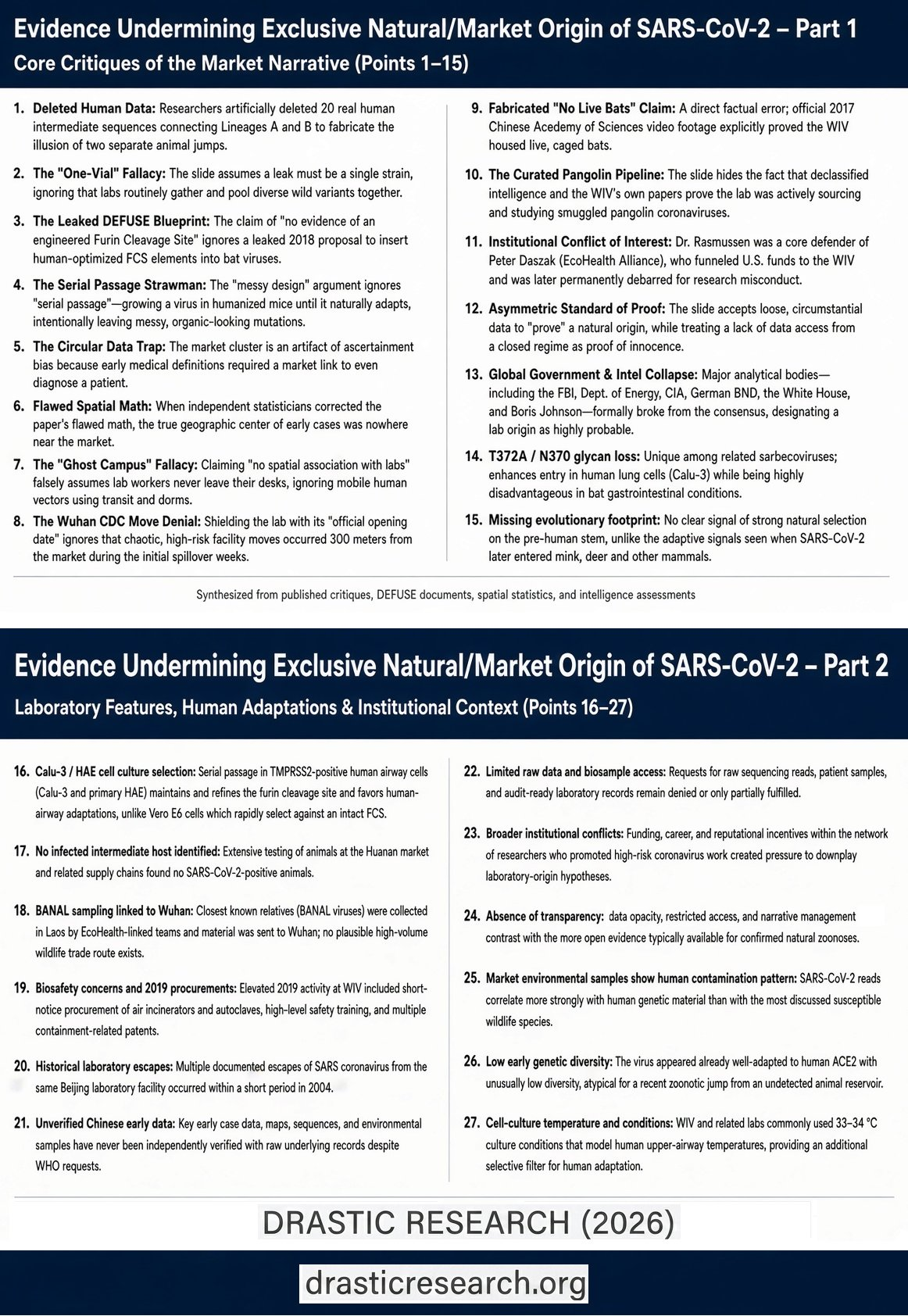
Latest DRASTIC News🔒 SSL VerifiedWelcome to the detailed analysis for drasticresearch.org. This domain is officially recognized as D.R.A.S.T.I.C. Research – D.R.A.S.T.I.C. Research. According to their official web presence, their primary focus is: "27 Critiques and Evidence Points against a Natural/ Market Origin #DRASTIC slide for dissemination through all appropriate forums, channels & spaces! Laboratory Cell Culture Footprints in the SARS-CoV-2 Glycan Shield Early natural origin arguments claimed that features like the furin cleavage site (FCS) required a living animal’s immune pressure. Later findings have weakened this claim;…".
By comparing drasticresearch.org to other leading websites in its niche, marketers and researchers can identify key traffic sources and growth opportunities. Explore our related resources below to find websites similar to drasticresearch.org.
Yes, according to our latest analysis, we detected a valid SSL certificate ensuring a secure connection.
As of September 29, 2026, drasticresearch.org holds an estimated domain authority score of 45/100 based on our VisitRank tracking algorithms.
You can find the best alternatives and similar sites to drasticresearch.org in our explore section, which includes competitors in the E-commerce & Retail sector.
Common Misspellings & Typo Domains for drasticresearch.org:
"#DRASTIC slide for dissemination through all appropriate forums, channels & spaces!"
"Early natural origin arguments claimed that features like the furin cleavage site (FCS) required a living animal’s immune pressure. Later findings have weakened this claim; while the FCS is lost in Vero E6 cells, it is maintained and refined in human respiratory cell lines like Calu-3.Simultaneously, the virus lacks a conserved glycan shield at position N370 due to a T372A mutation. Restoring this glycan locks the spike shut, dropping human lung cell replication over 60-fold. This change, alongside additional spike modifications (such as N519H and NTD glycan remodeling), favors a more open conformation optimized for human airway entry while reducing compatibility with the low-pH bat gut. Pre-2020 laboratory proposals explicitly detailed similar glycan ablations to analyze host-range effects. Crucially, recent phylogenetic modeling (Havens et al., 2026) reveals that the pre-human lineage was evolutionarily silent. This lacks the elevated mutation rates and host-specific adaptative signals observed whenever the virus spills back into secondary mammals like mink and deer. When combining these synchronized structural optimizations with the missing wild selective footprint, the data fits better with laboratory cell-culture passage (Calu-3, HAE), where immunological and gastric constraints are entirely absent, than with an as yet unfound and unknown intermediate animal host."
"This paper evaluates the structural, documentary, and genomic evidence for the potential laboratory adaptation of SARS-CoV-2, contrasting a synthetic assembly framework against standard natural zoonosis hypotheses. This study reviews claims that exogenous trypsin supplementation and engineered furin cleavage site (FCS) insertions, were utilized to bypass constraints. By analyzing the 2018 DEFUSE proposal alongside published Type IIS restriction enzyme protocols, some claim an explicit research intent to generate human-compatible chimeric backbones. This framework is then validated by recent comparative genomic and metagenomic audits, including the anomalous BsaI/BsmBI endonuclease fingerprint of SARS-CoV-2, the strategic positioning of a BsaXI site at the S1/S2 junction, and the unique pre-pandemic blueprint of the synthetic MERS-MA30 clone. Critically, empirical physical evidence from contaminated pre-pandemic Wuhan sequencing datasets is evaluated, which revealed an unpublicized, fully functional HKU4-related MERS chimeric infectious clone built on a WIV-linked pBAC-CMV vector using Type IIS “No See ‘m” engineering tools. Furthermore, this paper addresses alternative research-related pathways, evaluating how low-containment serial passaging forces human adaptation. This is directly supported by documented WIV protocols utilizing active 2019 pangolin coronavirus inventories, BsmBI cloning platforms, and 34°C upper-respiratory thermal shifts to drive cross-species tropism."
"A trio of interlinked studies, MacLean et al. (2021), Pekar et al. (2025), and Havens et al. (2026), has attempted to shape the prevailing zoonotic narrative for SARS-CoV-2 origins, claiming that bat sarbecoviruses evolved a “generalist” virus capable of efficient human transmission without significant pre-zoonotic adaptation or prolonged intermediate hosts. Employing phylogenetic tools (HyPhy, GARD, BEAST, RELAX), these papers infer minimal evolutionary change prior to emergence and attribute geographic gaps to wildlife trade. This critical examination reveals recurring methodological flaws, arbitrary parameter choices, selective data exclusion, unvalidated priors, and underpowered short-branch analyses, alongside interpretive biases that convert phylogenetic silence into affirmative zoonotic evidence. Notable flaws include the exclusion of MERS-CoV as a comparator despite its clear intermediate signals, the undervaluation of synonymous/codon biases that could mask lab optimization, and the absence of simulations testing engineered “minimal adaptation” scenarios. A further tension arises between Pekar et al. (2025), which mandates intermediates to bridge spatial distances, and Havens et al. (2026), which downplays their evolutionary role due to undetectable signals, effectively shifting goalposts from “find the intermediate” to “it was too brief to matter.” Contextual factors, including authors’ prior commitments and documented proposals like DEFUSE, compound these concerns. Collectively, the trilogy reinforces a zoonotic consensus through selective inference rather than conclusive disproof of alternatives."